


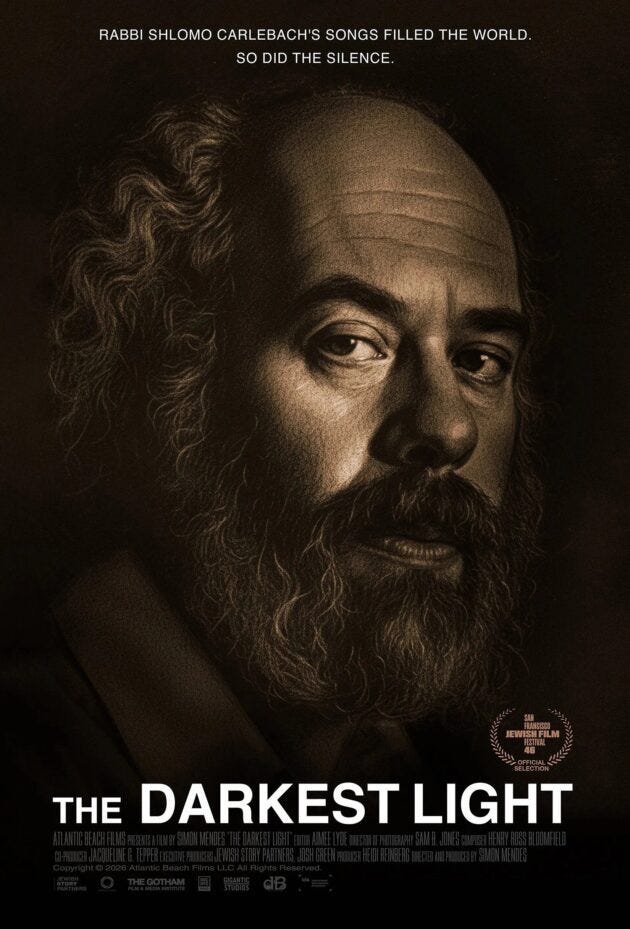
The Darkest Light is one of those documentaries that will haunt you long after it’s over. It follows the problematic legacy of Rabbi and musician Shlomo Carlebach who rose to fame on a message of love and light, only to be posthumously accused of being a predator and pedophile. Director Simon Mendes and writer Aimee Lyde pull focus on Carlebach‘s daughter Neshama Carlebach who is forced to reconcile the father she knew with the human that he was. We also consider just how personal the process of trauma recovery is. There is no right answer, only a positive direction.
The Doc opens with footage of Carlebach sitting amongst his fans with a guitar. All of them young adults, transfixed by a message of compassion and forgiveness. He urges everyone to remain vigilant of their mistakes noting that the distance between a good man and a bad man is just a day. We learn of his history escaping on one of the last boats out of Germany before Nazi control, only to land in New York where he began his music career. Right away his songs catch on in the Jewish community, crossing orthodoxical barriers to become songs regularly sung during worship. Ironically, Carlebach also championed Women’s rights both in and out of the temple. With every explored we get a growing sense of unease, knowing that we will soon have to explore our own feelings on the matter.
Director Simon Mendes and writer Aimee Lyde craft a thought-provoking exploration of duality in mankind. There is a paradoxical motif throughout. Shlomo Carlebach did an immense amount of good for millions of people, not just Jews, yet he was also a monster. He was a loving father, but we discover he overlooked the abuse of one of his daughters. He pushed for women to have a greater role in the temple, yet he secretly took advantage of them. He had a habit of believing the best version of his fellow man overlooking faults big and small. It’s as if Carlebach was quietly asking for forgiveness by forgiving others freely.
Neshama Carlebach’s journey is also an endlessly fascinating one. As a Jewish woman and survivor of abuse she must decipher a kaleidoscope of emotions and opinions from multiple communities. Her journey is one of conflict and deep emotions. The present must hold the actions of the past accountable while the emotions attached, are sometimes at odds with the facts. The candor that Neshama give to the camera puts us in her shoes, we feel her conflict.
The Darkest Light is one of the most important documentaries of the year. It demands accountability. It looks at the process of healing as a distinctly individual journey. While forgiveness is noble and godly, it isn’t always the answer for some. At one point, one of Shlomo Carlebach‘s victims simply says that the only thing that matters is “now.” Mendes and Lyde leave us with a whirlwind of thoughts and emotions by the end of The Darkest Light then leave us to sit with our thoughts. The answer for healing is just to keep moving forward.
The Darkest Light - 7/10